
Lincoln County Projected Release Dates
A scheduled or calculated date is a forecast within a sentence and custody system. An actual release date records an event that already happened. These dates can match, but often do not. A court may amend the judgment. NDOC may post jail credit, apply or remove sentence credit, aggregate consecutive terms, or receive a detainer. The Parole Board can grant, deny, defer, reconsider, or rescind an action. Placement approval can also take time.
For a Lincoln County jail stay, ask for the jail's current calculation and the court order behind it. For a Nevada prison term, review the NDOC profile and release data. If the date passes, confirm the later release entry. A transfer, residential confinement, or release to another authority is not the same as ordinary return to the community.
- Projected date
- A date calculated from current sentence and credit data that may change.
- Parole eligibility
- The point when parole may be considered, not a promised release.
- Discharge
- Completion of the sentence with no remaining community supervision.
- Detainer
- A lawful request or hold that can prevent physical departure to the community.
Find Lincoln County Projected Release
Begin with custody type. Lincoln County Detention Center handles local bookings and county sentences. Pioche Conservation Camp is an NDOC facility, so its sentence data belong to the statewide corrections system. A person sentenced in Lincoln County can also be held at another Nevada prison. Location in Pioche alone does not identify the record owner.
- Confirm whether the person is in county jail, NDOC custody, or another system.
- For county custody, obtain the signed judgment or current court order and ask the jail for its existing sentence calculation.
- For state prison, search the exact NDOC offender ID when available, then open the matching profile.
- Record NDOC's date labels exactly. Do not expand coded fields without an official data dictionary.
- Check the Parole Board record if parole may affect departure, while keeping the vote distinct from release.
- After the projected day, confirm the actual release entry with the agency that held the person.
The Lincoln County release-record search helps identify the correct custody path when the holding agency is not yet clear. A person missing from a live system might have transferred, changed status, or been entered under another identifier. Absence alone cannot supply a release date.
Lincoln County NDOC Date Fields
The NDOC Offender Search accepts an exact offender ID or first and last name. The form documents the percent sign as a wildcard. Use the offender ID when possible, then compare middle name, birth data, and other public identifiers before opening a profile.
NDOC does not present one plain field universally labeled “Projected Release Date.” Its sentence rows use coded labels including Sent. PED, Sent. MPR, Sent. PEXD, and Sent. RRD. Keep those labels as shown. Without an NDOC data dictionary, turning an abbreviation into a confident legal meaning risks changing the source. The fields indicate sentence calculations or eligibility, not an actual release event.
| NDOC source | What it contributes | Limit |
|---|---|---|
| Offender search profile | Identity, institution, custody, offense, sentence, parole, and coded date rows | Raw data and not an official record |
| Release download | Offender ID, booking episode, release date, and raw release description | Historical event data still need careful identifier matching |
| Parole download or report | Parole data or Board action context | A grant does not prove same-day departure |
| NDOC records request | Formal release or discharge documentation | Disclosure and fees follow the agency's process |
The official search form shows both ID and name routes.
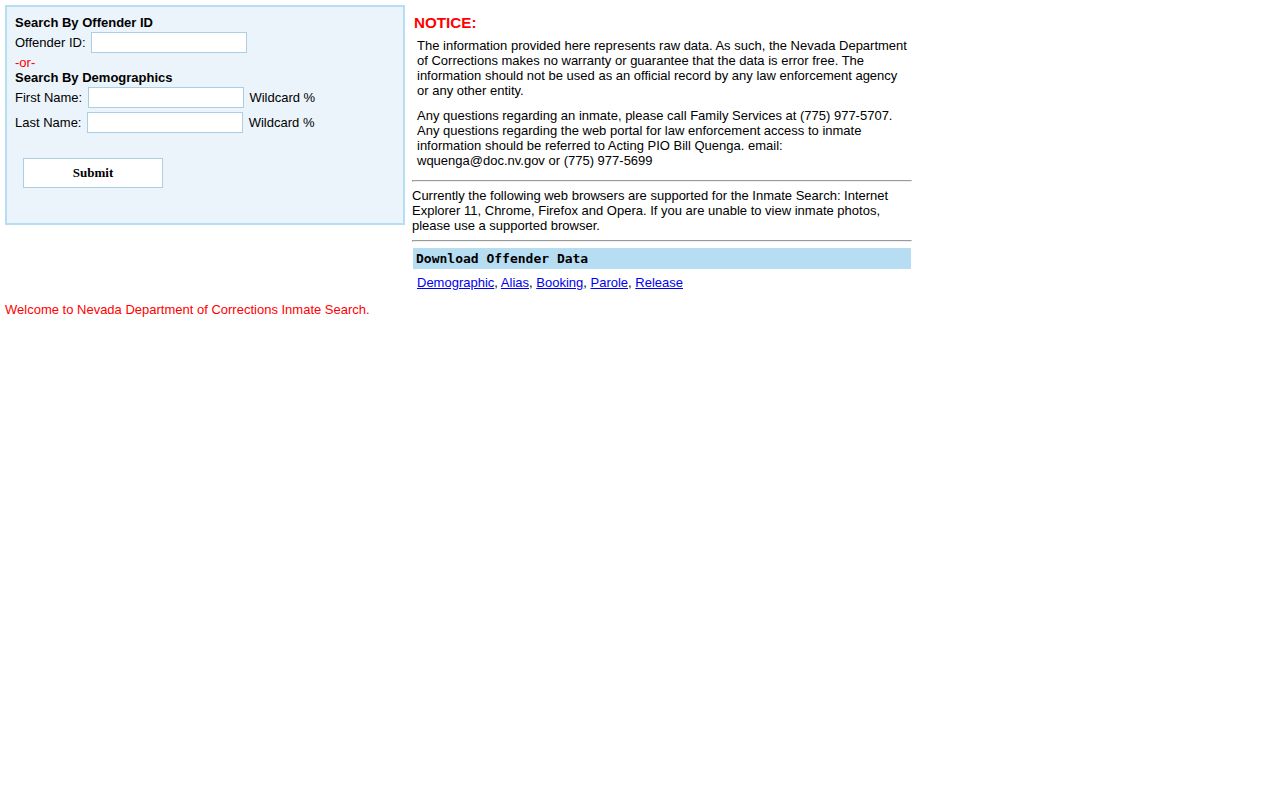
Its warning that the portal is raw data is a reason to preserve the displayed wording and request a formal record when proof matters.
Lincoln County Jail Date Calculation
County-jail sentences are not calculated from an NDOC profile. Use the sentencing order, credit for time served, the Sheriff's jail calculation, the structure of concurrent or consecutive terms, and any law that applies to the local sentence. Lincoln County has not published a county good-time formula or a weekend-release policy on the official pages reviewed.
A pretrial detainee often has no fixed release date. Bond must be posted or conditions met, and another case or hold may still prevent departure. A signed release order also comes before jail processing. The court record explains the authority; the jail movement record shows when the door event occurred. Call Lincoln County Detention Center at 775-962-5151 for current status, then request the identified calculation or booking-and-release entry when a written record is needed.
Route the court request by case level. Lincoln County has Meadow Valley Justice Court, Pahranagat Valley Justice Court, and Seventh Judicial District Court. Ask the clerk holding the case for the judgment, sentence, credit order, amended judgment, or release-related minutes. A lower-court matter and a felony district-court case should not be treated as one combined county docket.
Note: Ask for an existing calculation record rather than asking staff to create a new prediction or legal explanation.
Nevada Credits and Lincoln Releases
Nevada generally imposes minimum and maximum terms. Parole eligibility and sentence expiration are different. NRS Chapter 209 governs correctional credits, while NRS Chapter 213 governs parole mechanisms. The offense date and offense-specific restrictions matter, so a simple monthly credit rate cannot be applied to every person.
For qualifying offenses committed on or after July 17, 1997 under law effective through June 30, 2027, NRS 209.4465 generally provides 20 days of deduction for each month served when an eligible offender has no serious infraction and faithfully performs assigned duties. The Director may allow up to 10 more days per month for meritorious labor or study, along with specified education and program credits. Subsections and exclusions control whether credit affects the maximum term, the minimum or parole-eligibility term, or both.
Serious and violent offense exclusions are crucial. Credit may also be withheld, forfeited, or restored. Jail credit, sentence structure, and later corrections can alter the calculation. A rate stated without the judgment and offense date is not a dependable projected release date.
Lincoln County 85 Percent Myth
Nevada does not have a universal state rule requiring every prisoner to serve 85 percent. That shorthand often comes from federal law or another state's system. Under NRS 193.130, Nevada felony categories use minimum and maximum terms, and the imposed minimum generally may not exceed 40 percent of the imposed maximum. That ratio does not promise release at 40 percent. Nor does it create 60 percent sentence credit.
The actual result depends on the offense date, sentencing law, minimum and maximum terms, credit eligibility, offense-specific bars, presentence jail credit, consecutive or concurrent terms, and Parole Board action. A minimum date can open a parole decision process without fixing departure. A maximum date can also be reduced or changed under rules that do not apply to every offense.
Lincoln County 2027 Credit Change
Nevada has enacted a materially different credit framework that takes effect July 1, 2027. Subject to its terms, NRS 209.4467 will provide credit against the maximum equivalent to 35 percent and a separate minimum-term calculation, with an election process for some sentences imposed before that date. In 2026, it is future law. It should not be used as the present calculation.
This change makes the date of the calculation essential. A page, letter, or screenshot should state when the source was checked. For a date after the new law begins, confirm whether the sentence falls under the new section, an election, or the prior framework. Do not assume the later rule applies simply because a projected release falls after its effective date.
The effective date also prevents a present-day profile from being recalculated by hand with the future percentage. NDOC must apply the governing statute to the particular sentence. A request for the agency's existing calculation is more reliable than a private estimate based on the maximum term alone.
Why Lincoln Release Dates Change
A projected date is only as current as the judgment, credit record, parole action, and custody data behind it. Several events can move the display or change the actual departure path.
| Change | Possible effect | Best confirming source |
|---|---|---|
| Amended or corrected judgment | Changes sentence terms or the legal start point | Sentencing court |
| New presentence jail credit | Changes time credited toward the sentence | Court and NDOC calculation |
| Credit earned, lost, or restored | Moves an eligible sentence calculation | NDOC record |
| Consecutive term aggregation | Extends or restructures the full custody period | Judgment and NDOC |
| Parole action | May grant, deny, defer, or alter a release path | Parole Board action and NDOC release entry |
| Detainer or pending case | Can prevent return to the community | Holding agency and court |
| Data correction or lag | Changes a portal display without a new court event | NDOC official confirmation |
Placement also matters. Nevada P&P verifies a proposed parole residence. Residential confinement remains inmate custody even though P&P supervises the person outside a conventional institution. A favorable decision date, approved placement, physical departure, and parole supervision should be recorded as distinct milestones.
Confirm Lincoln County Actual Release
After the displayed day passes, look for the release event. NDOC's release data use offender ID, offender-book ID, release date, and release description. Match both identifiers, not merely a name. A released or discharged state offender may remain searchable after leaving an institution. “Parole” means supervision continues, while “discharge” means the sentence is complete. Another institution means transfer, not release.
The official NDOC result and record detail can show how released or discharged information remains available.
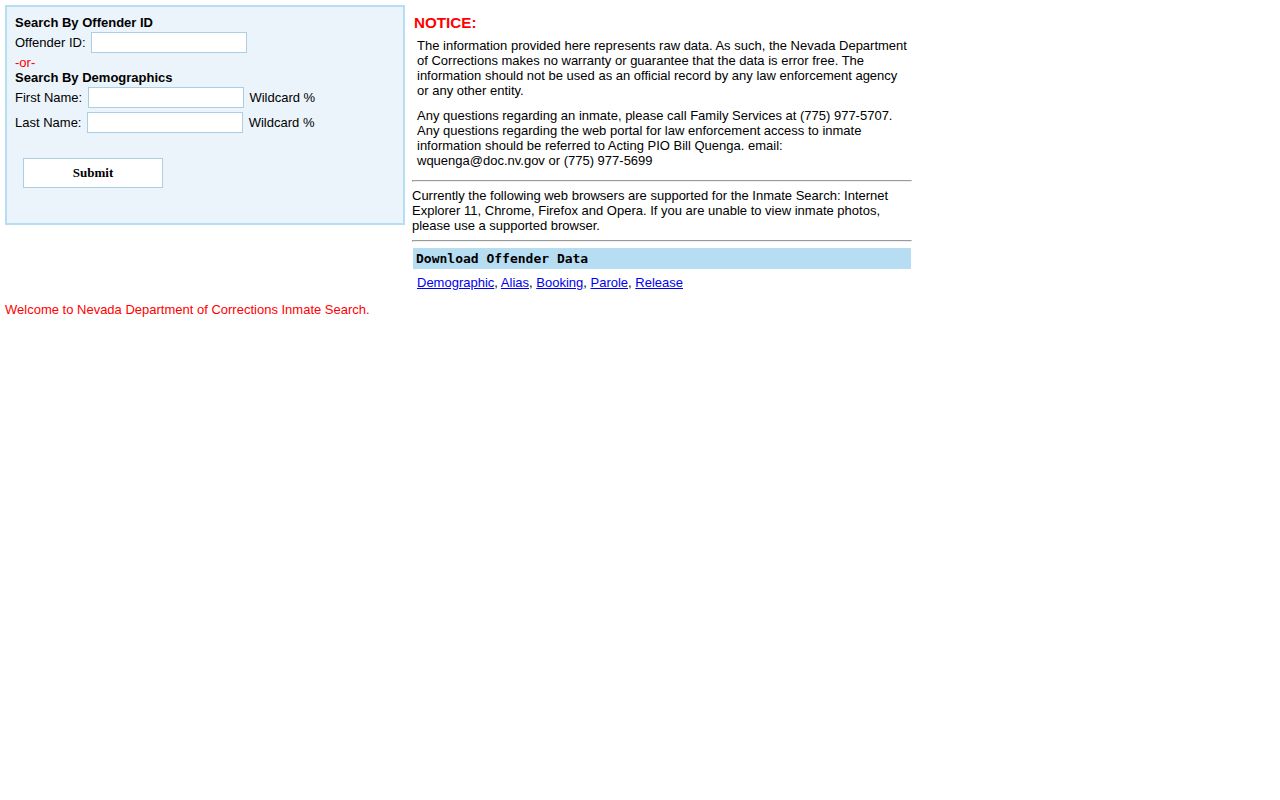
For formal proof, request the release or discharge record from NDOC Records. Nevada S.A.V.E. can send a useful event alert, but the Lincoln County notification instructions explain why that automated message still needs agency confirmation.
NDOC directs offender-record questions through its records and information channels. A useful request identifies the offender name, NDOC number, date range, release or reception history, and whether a certified copy is needed. Ask for an estimate and keep the requested fields narrow. The public profile is suited to discovery, while the agency-produced record is the stronger source for the completed event.