
Lincoln County Three-Day Feed Status
The Lincoln County Sheriff’s official pages publish no inmate roster, booking archive, released-person tab, or rolling 72-hour report. That means there is no official web page that can be opened on Monday to review every Friday-through-Sunday departure. Search results often lead to a Lincoln County elsewhere, so the state and facility identity must be checked before relying on any list. Nevada’s county page provides jail information but no names, release timestamps, reasons, booking images, refresh schedule, or web-retention period.
The useful official starting point is the Lincoln County Detention Center page. Its visitation and deposit vendors are not hidden roster tools. A successful service lookup can suggest current custody, but a failed lookup does not show when or why custody ended. Direct staff confirmation followed by an existing release log or booking record is stronger.
Check Lincoln County Three-Day Releases
Begin by writing the start and end of the period. A Monday inquiry might need Friday, Saturday, and Sunday as separate dates rather than the loose phrase “over the weekend.” Call the detention center at 775-962-5151 with a full name and approximate booking date. Ask whether the person is currently housed and, if not, whether staff can distinguish community release from transfer. The phone route is current; the written route documents the historical span.
- Set the exact three-day start and end dates, including times if the boundary matters.
- Confirm the custody episode belongs to Lincoln County, Nevada, and collect the full name, booking date, and case number if known.
- Call the Sheriff’s 24/7 detention number at 775-962-5151 and ask whether the person remains housed.
- If not housed, ask whether the recorded movement was a release, transfer, or delivery to another authority.
- Request an existing release log or the person’s booking and release record for the stated dates.
Use the Lincoln County 24-hour release process when only today’s movement matters. It puts more weight on immediate phone confirmation and a narrower same-day period.
Lincoln County 72-Hour Fields
Lincoln County exposes no online three-day field set. The entries below are therefore fields to identify in an existing report or person-specific booking record, not claims about the jail database’s labels. For a multi-day span, the date and time matter because they place the event inside or outside the requested window.
| Requested field | What it can establish |
|---|---|
| Name and booking number | Connects the response to the correct person and custody episode. |
| Admission date and time | Separates the relevant stay from earlier or later bookings. |
| Release date and time | Places the event within the three-day period. |
| Release type or authority | May distinguish bond, court order, time served, or another basis. |
| Receiving agency or destination | May show that the person transferred and did not return to the community. |
Compare the jail movement time with the court order. A judge may authorize release before staff complete checks, return property, or process another hold. Bond means physical release pending the case, not dismissal. Time served may close local custody while probation or another obligation survives. Transfer means the person stayed in custody under another agency.
Lincoln County Weekend Release Timing
A 72-hour inquiry is most useful when office closures or delayed awareness push the search past the same day. Yet a weekend does not create a different legal release type. Bond, a court order, sentence completion, transfer, and another hold still control the event. Processing time can extend beyond the order, so the signed court document and jail timestamp answer different questions.
Lincoln County’s request framework allows five business days for an agency response. Saturdays, Sundays, and holidays can therefore widen the gap between an urgent status call and the documentary reply. The deadline can result in access, notice that the record is unavailable, a legal basis for withholding, or a later expected availability date. It is not guaranteed production by the fifth business day.
For one named person, the Lincoln County released-inmate search can route the inquiry to NDOC, court, federal, or notification sources if the person did not simply return to the community.
Request Lincoln County Three-Day Records
After the call, follow the Sheriff’s public-record instructions. Send the form to FOIA@lincolncountynv.gov, mail it to Lincoln County Sheriff’s Office, PO Box 570, Pioche, NV 89043, or deliver it in person. Ask for an existing jail release log or report for the exact dates. If the goal is one person, request that person’s booking and release entry instead.
Do not demand that the Sheriff calculate or compile a new list if none exists. Identify the existing record sought and request electronic delivery. Include names, booking dates, arresting agency, case number, and requested release fields. Ask for an estimate before extraordinary work. The form’s $35-per-hour line relates to extraordinary staff work, not a standard fee for every request.
Juvenile and other confidential information may be withheld. If material is denied, ask for the legal authority and any reasonably separable public portion. Avoid placing unnecessary private data in the request because the form warns that requests and responses may themselves become publicly viewable.
Lincoln County Three-Day Outcomes
A three-day result must say what ended. The Sheriff owns the county-jail movement. A court owns its order and final case disposition. NDOC owns state-prison release and discharge data. Another agency may have accepted a transfer even though the Lincoln County custody episode ended. Without that distinction, a list of departures can wrongly imply freedom.
| Status | Best source | Meaning |
|---|---|---|
| Still in county custody | Detention center phone confirmation | The person remains housed at the county jail. |
| Released from county custody | Booking/release record | The local custody episode ended at a recorded time. |
| Transferred | Jail movement entry and receiving agency | County custody ended, but custody continued elsewhere. |
| State-prison release or discharge | NDOC offender and release records | A separate state sentence, not a county-jail release event. |
NV S.A.V.E. can show current custody or supervision and send alerts, but its information is not the official NDOC record. People no longer in custody may not appear. A no-result therefore cannot identify which of the three days contained a release. Use the owning agency’s record for a firm date.
Note: Record the exact displayed status and search time because notification data and custody records can update after a holiday or weekend.
No Lincoln County 72-Hour Feed
Lincoln County’s lack of a rolling feed is a verified local condition, not a reason to substitute an unofficial three-day list. The official detention center screenshot shows the facility source without a roster or recent-release filter. A list from Nebraska, Missouri, Mississippi, or another Lincoln County cannot answer a Nevada release question.
Search dates should be preserved with the result. If a caller later learns that a person entered NDOC, another county jail, or federal custody, the earlier local answer can be read as the end of one custody episode rather than a claim of community freedom. That distinction is vital across a three-day review because more than one movement may occur within the period.
The official detention center listing is the source for the jail’s identity and contact path.
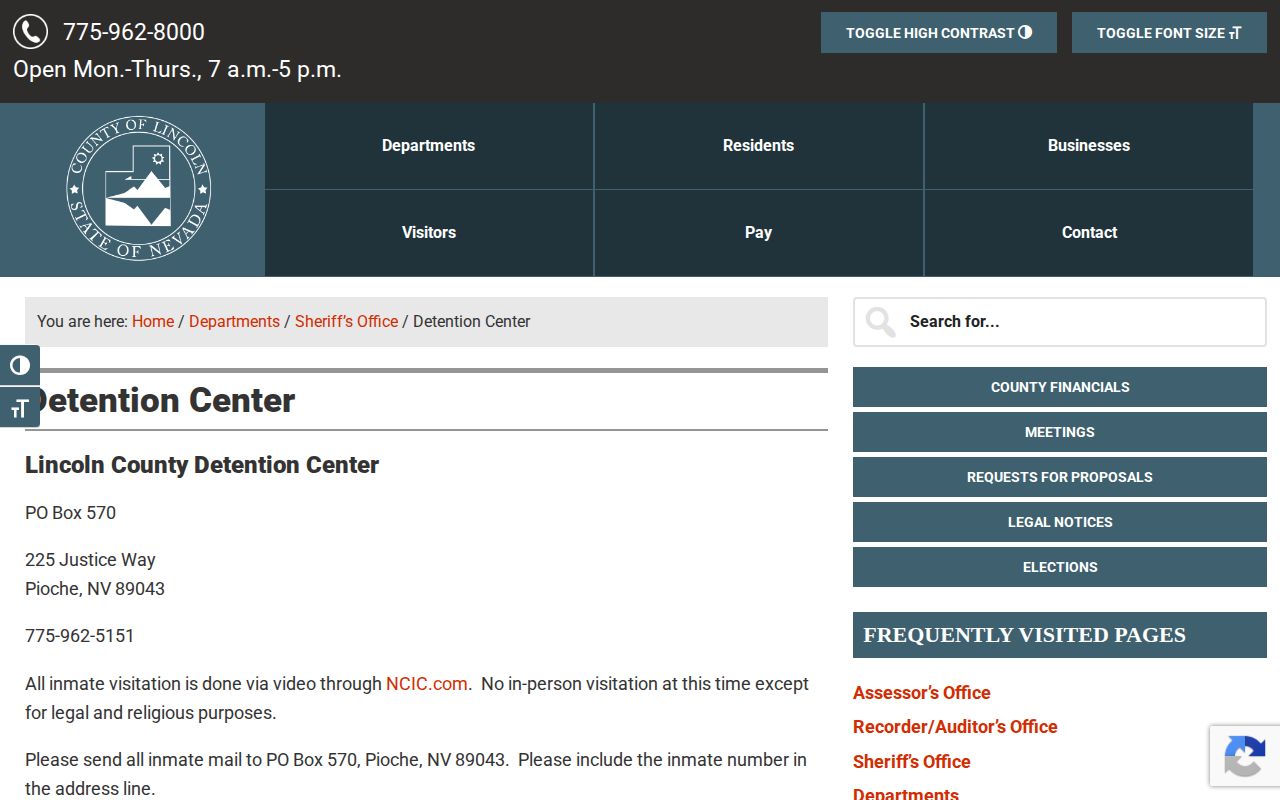
The image anchors the three-day workflow to the correct Nevada facility and shows why exact dates must be supplied by phone or request.