
Lincoln County Release Records
“Released” means one custody episode ended. It does not always mean a person walked free. Lincoln County Detention Center may release someone on bond, recognizance, a court order, or after a county sentence. Staff may instead transfer the person to another jail, the Nevada Department of Corrections, the U.S. Marshals Service, or another authorized custodian. A death can close a custody record but should never be described as an ordinary release.
The agency that controls the door records the physical event. The Sheriff owns the local jail movement record. A court owns its bail, dismissal, judgment, or sentencing order. NDOC owns state-prison admission, parole, and discharge data. These records answer different questions, so a sound verification pairs the release time with the legal document that authorized or followed it.
- Parole
- Release from prison into continuing legal supervision.
- Probation
- A court-ordered supervision term that may begin without a prison stay.
- Discharge
- Completion of the sentence with no supervision needed for that sentence.
- Time served
- Completion of the custodial part of an order, though other duties may remain.
Lincoln County Release Types
The recorded reason controls what should be checked next. Bond ends physical detention while the case continues. A dismissal may remove one legal basis for custody but does not defeat another warrant or sentence. Parole ends prison confinement but starts or continues Board jurisdiction and field supervision. Transfer changes the custodian, not the person’s overall custody status.
| Release entry | Meaning | Next source |
|---|---|---|
| Bond or recognizance | Community release while the case remains open | Jail timestamp and court docket |
| Time or sentence served | Ordered local custody was satisfied | Release record and sentencing court |
| Parole or mandatory release | Prison confinement ended with supervision | NDOC, Parole Board, and P&P |
| Discharge or expiration | The identified state sentence ended | NDOC release record |
| Transfer or federal hold | Custody continued under another agency | Receiving agency’s system |
Residential confinement also needs care. Nevada describes a person in that placement as an inmate even though P&P may supervise the placement away from a conventional prison. A status label should be quoted as the agency presents it rather than simplified into “free.”
Fields in Lincoln Release Records
Lincoln County publishes no jail data dictionary. The fields below are therefore focused request targets, not a claim about exact labels in the jail system. Ask for the event tied to a known booking, and use a date range, case number, or arresting agency to reduce mistaken identity.
| Field | What it establishes |
|---|---|
| Name and booking number | The identity and local custody episode |
| Admission date and time | When the jail accepted custody |
| Release date and time | When that physical custody ended |
| Release type or authority | The recorded basis for departure |
| Charges or sentence | The case linked to the booking |
| Receiving agency or destination | Whether custody continued elsewhere, if releasable |
A booking number is stronger than a name match. Keep the court case number separate, because the jail timestamp and final disposition may occur months apart. No official source states how long an old Lincoln County booking stays available online because there is no public booking search. Request the identified historical record even when nothing appears on the web.
Request Lincoln County Release Records
The Sheriff’s forms page explains that an identifiable existing police record may be requested under Nevada’s public-records law. The county accepts requests by email, mail, or in person. Juvenile records are excluded. Ask for an electronic copy and an estimate before extraordinary work begins.
- Identify the person, approximate booking date, arresting agency, and case number if known.
- Name the existing record, such as the booking and release record, jail movement entry, or release authorization.
- List the needed fields, including admission time, release time, release category, and receiving agency if publicly releasable.
- Send the form to FOIA@lincolncountynv.gov, mail it to PO Box 570, Pioche, NV 89043, or deliver it in person.
- Ask for segregable public portions and the cited legal basis if part of the record is withheld.
225 Justice Way
Pioche, NV 89043
Mail: PO Box 570, Pioche, NV 89043
Phone: 775-962-5151, answered 24/7
The form states a five-business-day response framework. That is a deadline for a response, not a guarantee that every record will be produced in five days. Its $35 hourly line applies to extraordinary staff work, not every request. Current copy and media charges depend on the county policy and an estimate.
The official request page is visible in the county’s own record-access instructions.
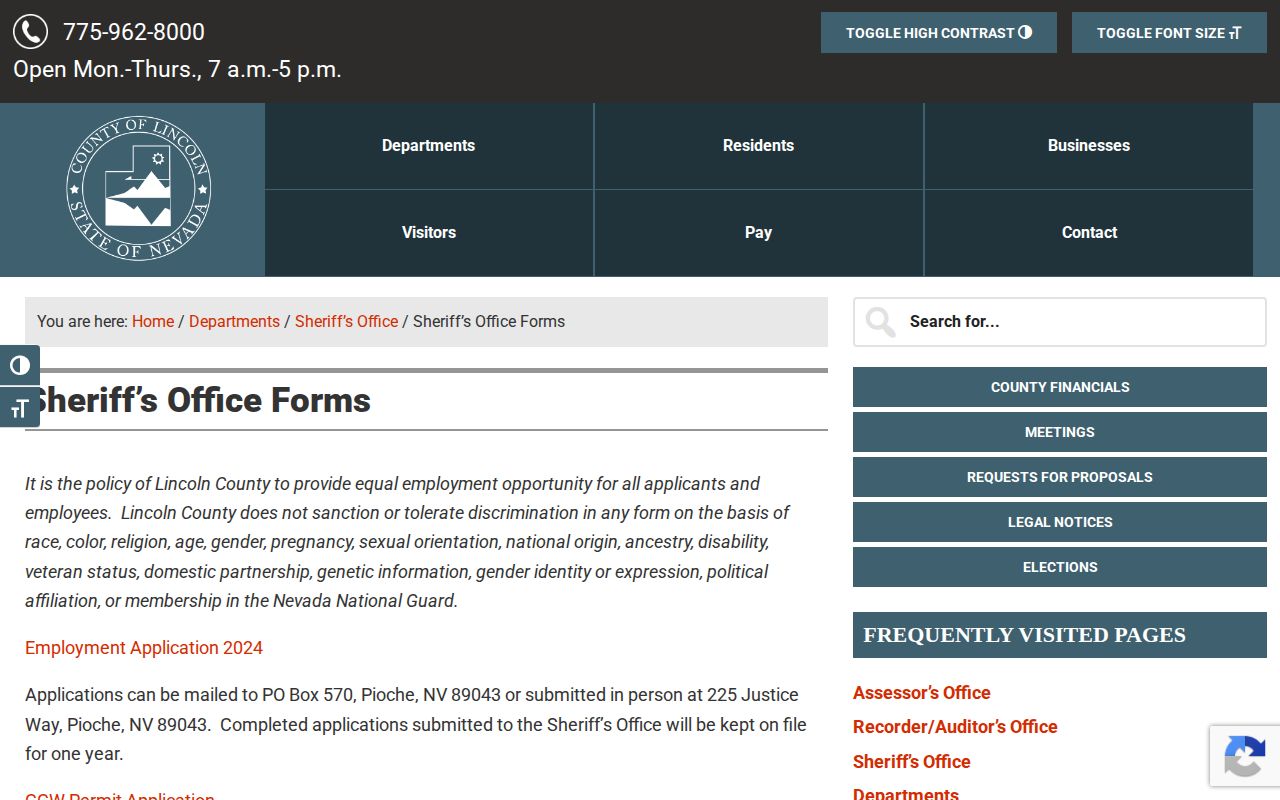
The captured page reinforces why a narrow request for an existing release entry works better than asking staff to create a new explanation.
Note: The request and the response may become publicly viewable, so omit unneeded private facts and confidential identifiers.
Lincoln Release Law and Sealing
NRS Chapter 239 governs access to nonconfidential Nevada government records. NRS 239.0107 sets the five-business-day response framework. NRS 239.052 permits a fee for extraordinary personnel or technology use after appropriate notice. The custodian may still apply privacy, active-investigation, victim, juvenile, and other legal limits.
Nevada generally uses record sealing rather than a broad process called expungement. NRS Chapter 179 provides rules that vary with the offense and disposition. A sealing order limits ordinary public access, but it should not be described as rewriting every operational record. Do not reproduce sealed material found in an old copy.
Find Lincoln County Released Inmates
Start with the custody system, not a broad name search. The Lincoln County Detention Center has no public roster. A missing web result therefore proves nothing. For a recent local booking, call the jail, ask if the person is presently housed, and ask whether staff can distinguish release from transfer. Then seek the booking/release entry for documentary proof.
- Classify the episode as county jail, Nevada prison, federal custody, immigration custody, or post-release supervision.
- Use the identifier owned by that system: booking number, NDOC offender ID, BOP register number, A-number, or court case number.
- Record the exact status, source, and check time. Do not treat “not found” as “released.”
- Compare the facility event with the court order, NDOC release entry, or receiving agency record.
- Request an agency-produced record when exact time, authority, or destination matters.
The absence of a county feed is why the 24-hour release route begins with a phone check and existing-record request. A current-custody service, video-visitation link, or deposit account is not a release certificate.
Lincoln NDOC Offender Search
For a Nevada prison sentence, use the NDOC Offender Search. An offender ID is the safest input. The name form accepts first and last name and documents the percent sign as a wildcard. Compare middle name, birth information, offender number, and other lawful public identifiers before opening a profile.
| Search field | Use | Caution |
|---|---|---|
| Offender ID | Exact state identifier | Best protection against same-name errors |
| First and last name | Demographic search | Try verified variants and aliases |
| % wildcard | Partial-name search | Review all candidates carefully |
| Release download | Offender ID, booking ID, date, description | Join by identifiers, not name alone |
The portal links Demographic, Alias, Booking, Parole, and Release data. Its sentence table uses coded labels such as Sent. PED, Sent. MPR, Sent. PEXD, and Sent. RRD. Those labels should not be expanded without an NDOC data dictionary. A profile at a new institution indicates transfer. Parole indicates continuing supervision. Discharge indicates completion for the identified sentence.
The official search form shows the two search routes and NDOC’s raw-data warning.
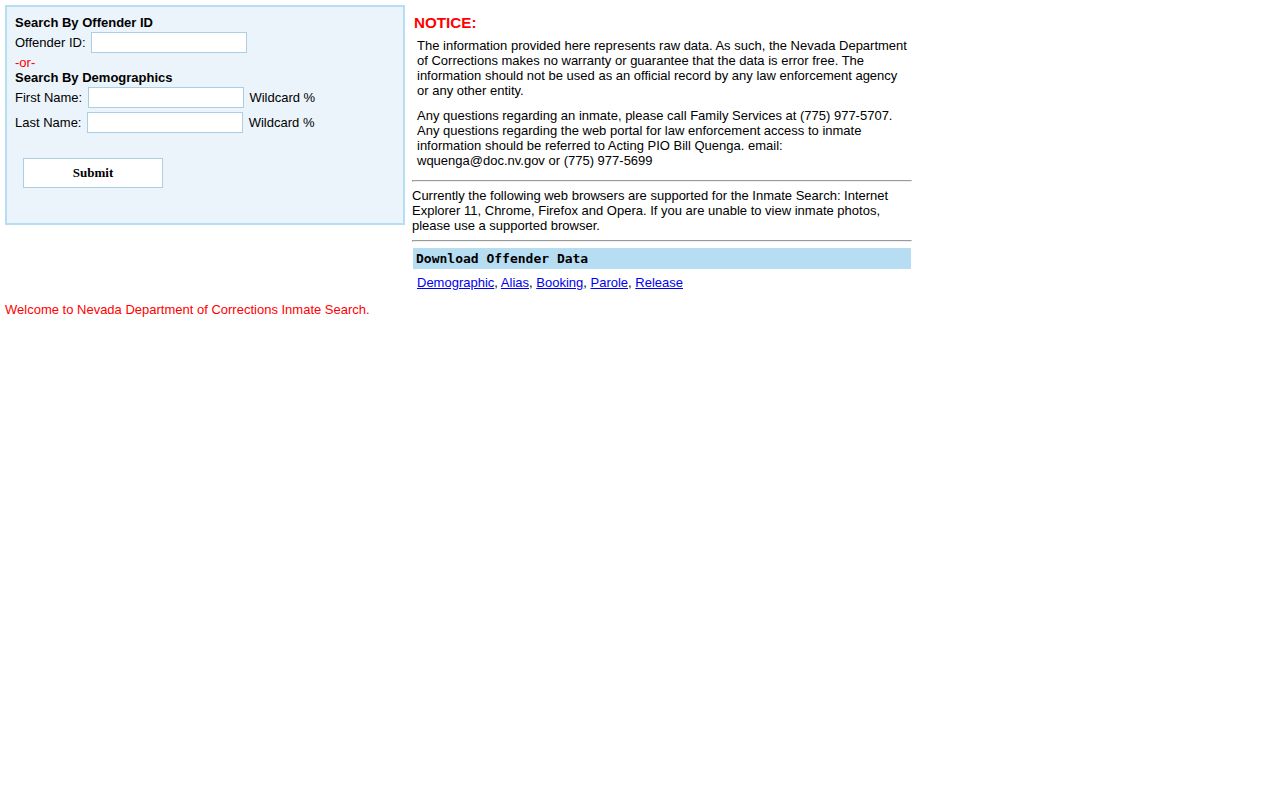
The screenshot shows why the portal is useful for discovery but not a certified release record. NDOC Family Services, the institution, or Offender Management Division can address formal record needs.
Lincoln Release Orders in Court
Lincoln County has three local court routes, not one generic clerk. The county courts index identifies Meadow Valley Justice Court, Pahranagat Valley Justice Court, and Seventh Judicial District Court. Justice courts may hold misdemeanor dispositions and early felony records. The District Court holds felony judgments and sentencing records.
Request the docket, bail or release order, hearing minutes, judgment, sentence, commitment, and any later amended, probation-discharge, revocation, or sealing order. The signed order is stronger than a brief docket label. Pair it with the jail timestamp because an order may be signed before jail staff complete release processing.
The official District Court page places Lincoln County court days on the second and fourth Fridays.
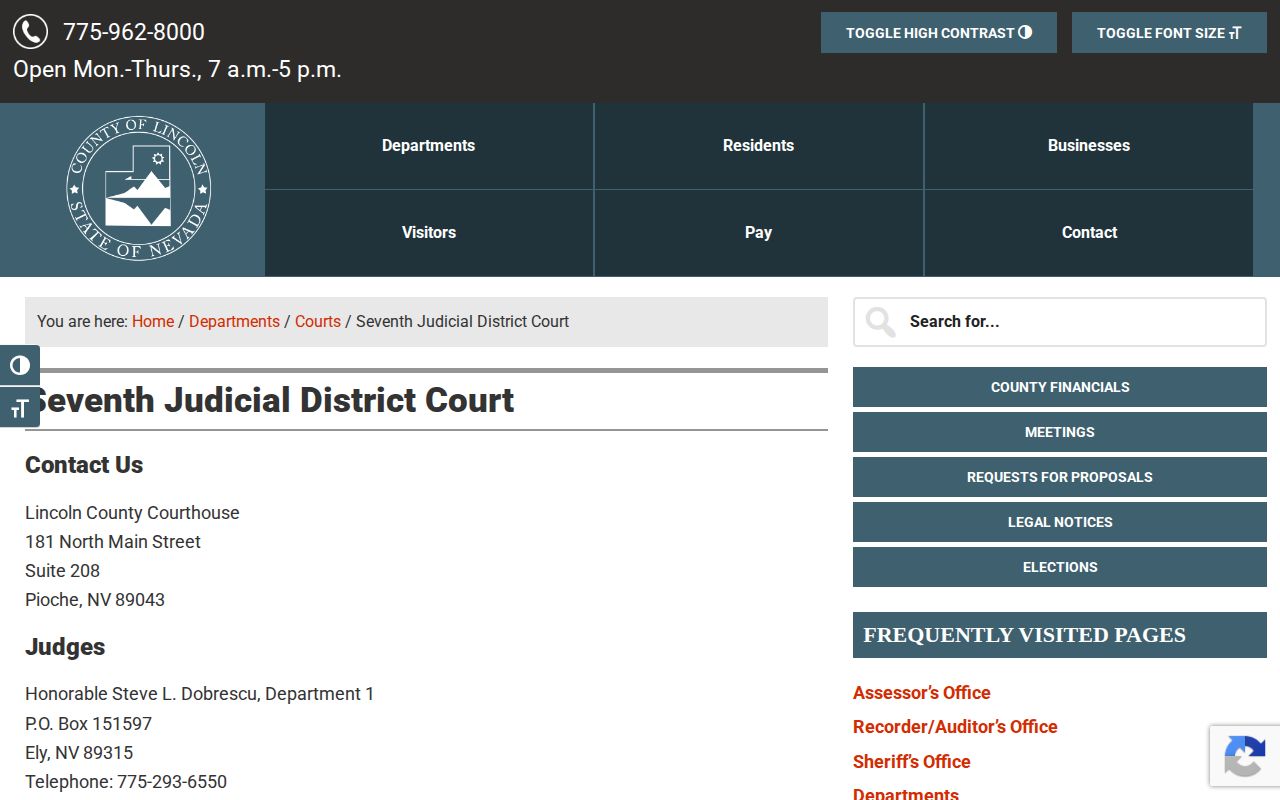
That rural schedule can explain timing gaps, but it cannot predict when a named person will leave the jail.
Lincoln Release Alerts and Supervision
Nevada’s current automated service is Nevada S.A.V.E. VINE search and notifications ended in August 2025, even though the Lincoln County Sheriff page still contains legacy VINE language. S.A.V.E. can provide custody or supervision status and phone, email, or text alerts. Its automated information is supplemental, not an official NDOC record.
The Nevada Board of Parole Commissioners makes parole decisions. The Nevada Division of Parole and Probation supervises parolees and probationers. A Board grant is not the physical release time. NDOC records the prison departure, and placement approval or a detainer can delay it. The Ely office route serves Lincoln County supervision matters.
The Nevada Sex Offender Registry is a separate legal registry. It is not a list of all Lincoln County released inmates. Presence supports only the registry status shown, and absence proves neither custody nor release.
A S.A.V.E. no-result deserves the same care as any other missing record. Repeat the search with the offender ID, a legal name, verified variants, and the portal’s partial-name method. Then check the jail, NDOC, P&P, and court sources. S.A.V.E. explains that a person no longer in custody may not appear. Its periodic updates also mean a recent change can take time to reach the public view.
Federal Lincoln Release Checks
The BOP Inmate Locator covers federal inmates from 1982 forward. A historical result may show a release date and “Not in BOP custody.” That statement concerns BOP custody only. PACER can supply federal judgments, release orders, supervised-release terms, and later revocation orders. A recent pretrial detainee may remain with the U.S. Marshals Service before any BOP designation.
The ICE Online Detainee Locator is mainly a current-custody tool and may include recent releases for a limited period. A county transfer to ICE ends Lincoln County custody but not custody overall. No official source identified a dedicated ICE detention facility in Lincoln County, so the county jail must not be labeled an ICE facility.
The official federal locator describes its population and release-result limits.
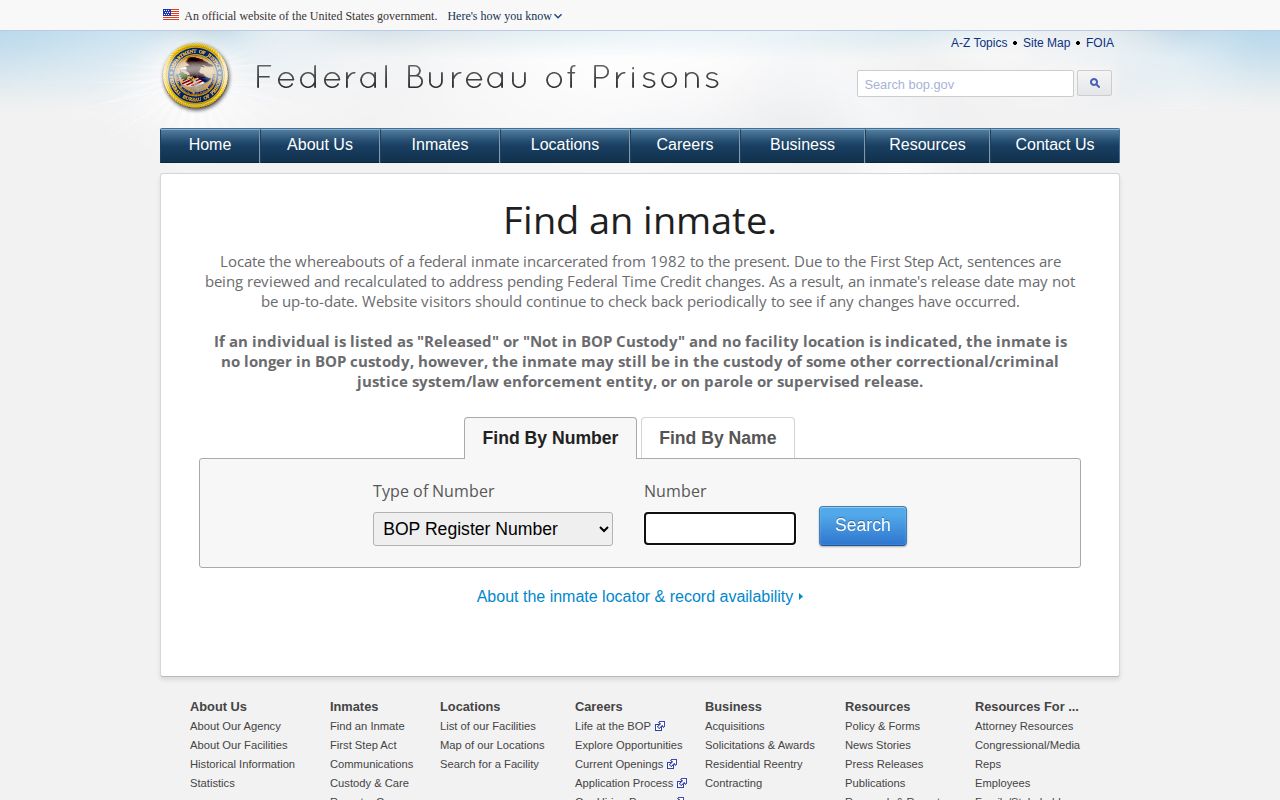
The locator’s wording should be kept narrow and checked against state, local, immigration, and court sources when another custody path may exist.
Federal court records add the legal context that a locator cannot. The judgment states the sentence, and later docket entries may record release orders, supervised release, or revocation. A person held before trial can move through U.S. Marshals custody without appearing in the BOP system yet. A missing BOP result should therefore send the inquiry to the federal docket or counsel instead of producing a claim about release.
Pioche Release Systems Differ
Pioche has two custody sites with different owners. Lincoln County Detention Center sits on Justice Way and handles local detention. Pioche Conservation Camp sits on Hardtimes Road and is a state correctional camp. Asking only whether someone is “in Pioche” can send a search into the wrong system.
PCC opened in 1980 as Nevada’s first rural conservation camp and works with Nevada Division of Forestry crews. A person who disappears from PCC’s location has not necessarily been released. NDOC may have transferred that offender, approved residential confinement, granted parole, or recorded discharge. Use the statewide offender ID and state release history.
Getting Home After Lincoln Release
Lincoln County Transportation serves Pioche, Panaca, Caliente, and Alamo through a mix of deviated fixed-route and demand-response service. County materials describe operation Monday through Thursday and one Friday trip per month to Utah. Those facts do not promise pickup at the jail door.
A person or family should call Lincoln County Human Services at 775-962-8084 before relying on the bus. Release processing, court orders, property return, and transportation schedules may not align. Arrange a safe pickup plan where possible, and do not infer a release time from court scheduling.
Lincoln Released Versus In Custody
Each system answers a narrow question. A live jail statement addresses current local custody. A release entry records departure. A court order explains legal authority. NDOC tracks Nevada prison terms. Federal and immigration systems cover their own populations.
| Situation | Best starting source | What absence means |
|---|---|---|
| Recent county booking | Detention Center phone and county record | No online roster exists |
| Nevada prison term | NDOC offender and release data | Check transfers, parole, or discharge |
| Federal sentence | BOP and federal docket | Not in BOP may still allow other custody |
| ICE custody | ICE ODLS and follow-up | No result is inconclusive |
| Supervision | P&P, Board action, and court | No public name locator is verified |
Why is a released person missing? A current-custody list, when one exists, normally stops showing a person after departure. Lincoln County has no public list at all, so agency confirmation and the event record are essential.
A negative result is the weakest form of evidence. Repeat the search with stable identifiers and verified spelling, check the neighboring custody system, and note the time of the search. The person may have transferred, entered under an alias, fallen outside the database population, or been affected by a disclosure rule or update lag. “Not found” should never be converted into “released” without an affirmative event record or agency confirmation.
Keep the identifiers from each system separate during follow-up. A Lincoln County booking number identifies a county jail episode, an NDOC offender number identifies a state correctional record, and a court case number identifies the legal proceeding. Matching the right numbers prevents a later arrest, transfer, or sentence from being mistaken for the release being researched. When two records disagree, ask the agency that owns the event to clarify its own entry and preserve the date of that response.
Lincoln County Release Facilities
Lincoln County Detention Center handles local jail custody. A person may return to the community or move to another custodian. Pioche Conservation Camp is an NDOC state facility, so release and parole data belong to Nevada’s statewide records.
- Lincoln County Detention Center: county-jail phone verification and booking/release request.
- Pioche Conservation Camp: NDOC offender search, release history, and state records.
Other Lincoln County commitments can be housed at any NDOC institution. Federal prosecutions and immigration custody require federal sources, even if a county facility handled one short part of the movement.