
Lincoln County Parole or Probation
Parole follows release from a Nevada state-prison sentence. The Nevada Board of Parole Commissioners decides parole matters, while the Nevada Division of Parole and Probation, often shortened to P&P, carries out field supervision. A Board vote and the later prison-door event are not the same record. NDOC confirms when confinement ended. P&P is the better source for the supervision route after that event.
Probation usually begins with a sentencing-court order. A Lincoln County defendant may leave the county jail and start or resume probation without ever entering NDOC. The correct court file can show the probation term, later changes, revocation, or discharge. P&P may supervise the person, but the signed court order remains the key source for what the judge imposed.
| Question | Parole | Probation |
|---|---|---|
| How it begins | Release from prison under Board authority | Sentence or order entered by a court |
| Core decision source | Parole Board hearing and action records | Lincoln County court file |
| Field supervision | Nevada P&P | Nevada P&P when state supervised |
| Release proof | NDOC release entry, not the vote alone | Jail movement record if the person was confined |
| How it ends | Expiration or lawful early discharge | Court or agency discharge, expiration, or other order |
- Parole
- Release from prison into continuing legal custody and supervision.
- Probation
- A court-ordered community sentence or supervision term.
- Discharge
- The formal end of a sentence or supervision duty.
- Absconder
- A supervised person alleged to have stopped reporting or left control without approval.
Check Lincoln County Supervision
No verified public Nevada P&P search allows a visitor to enter a name and receive a live supervision result. Verification instead requires a short record chain. Begin with a stable identifier, such as an NDOC offender number or court case number. Names alone can collide. Then keep the hearing decision, release event, and current supervision question separate.
- For a state-prison case, use the NDOC Offender Search to match the offender ID and review parole or release data.
- Check the monthly hearing schedules and the matching Board action report. A scheduled hearing does not prove release.
- Find the later NDOC release entry. A grant can be followed by placement review, a detainer, or more custody.
- Contact the Ely P&P office for the Lincoln County supervision route and ask what status information is publicly releasable.
- For probation, obtain the sentencing order and any later discharge, modification, or revocation from the court holding the case.
The Lincoln County released-inmate search explains how the jail, NDOC, and court records fit together when the custody source is uncertain. A person absent from the county jail is not automatically on supervision. They might have been transferred, discharged, or held by another authority.
Note: Record the date checked because NDOC calculations, Board reports, and supervision status can change after an update.
Lincoln County Supervision Office
Lincoln County belongs to P&P's Northern Command. The current state directory routes the county through the Ely office. This is the locally relevant field office after a parole release and for a state-supervised probation route. An older page may show another Avenue F number, so the consolidated directory should control.
Nevada P&P, Ely Office
Address: 1665 Avenue F, Suite B, Ely, NV 89301
Phone: 775-289-1636
Fax: 775-289-1638
Command: Northern Command, serving Lincoln County
The official P&P contact directory shows the Lincoln County assignment and Ely office. Its role is field supervision, not the Parole Board's vote and not the Sheriff's county-jail release log.
The image below comes from that official directory and helps confirm the county-to-office routing.
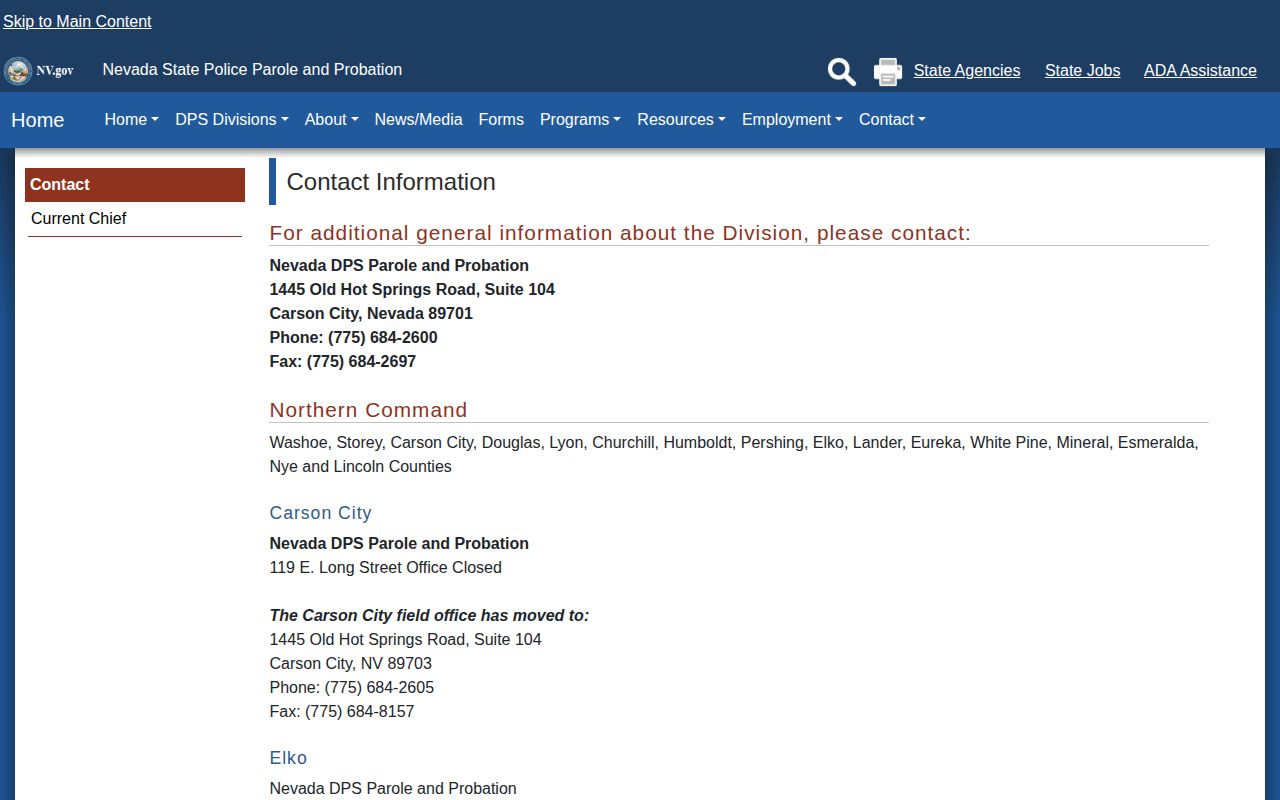
Use the listing to reach the proper office, then provide the offender or case identifier and ask only for information the agency may lawfully disclose.
Lincoln County Parole Decisions
The Parole Board posts monthly hearing schedules, including regular parole, violation, condition-modification, lifetime-supervision, and early-discharge materials. A person may be removed from a schedule after a transfer or an eligibility finding. The monthly action reports can show grant, denial, deferral, reconsideration, rescission, condition changes, or a violation outcome. Read the legend. Do not force every entry into a simple granted-or-denied label.
The Board says ordinary hearings are generally set about three months before the minimum eligibility date. That timetable does not fix the actual release day. Four members must agree before a decision is announced, and the institution and person are notified after ratification. The Board describes notice within 10 working days. Placement approval, a detainer, or another lawful hold can still delay physical departure.
The official Monthly Parole Board Actions index is the results path.
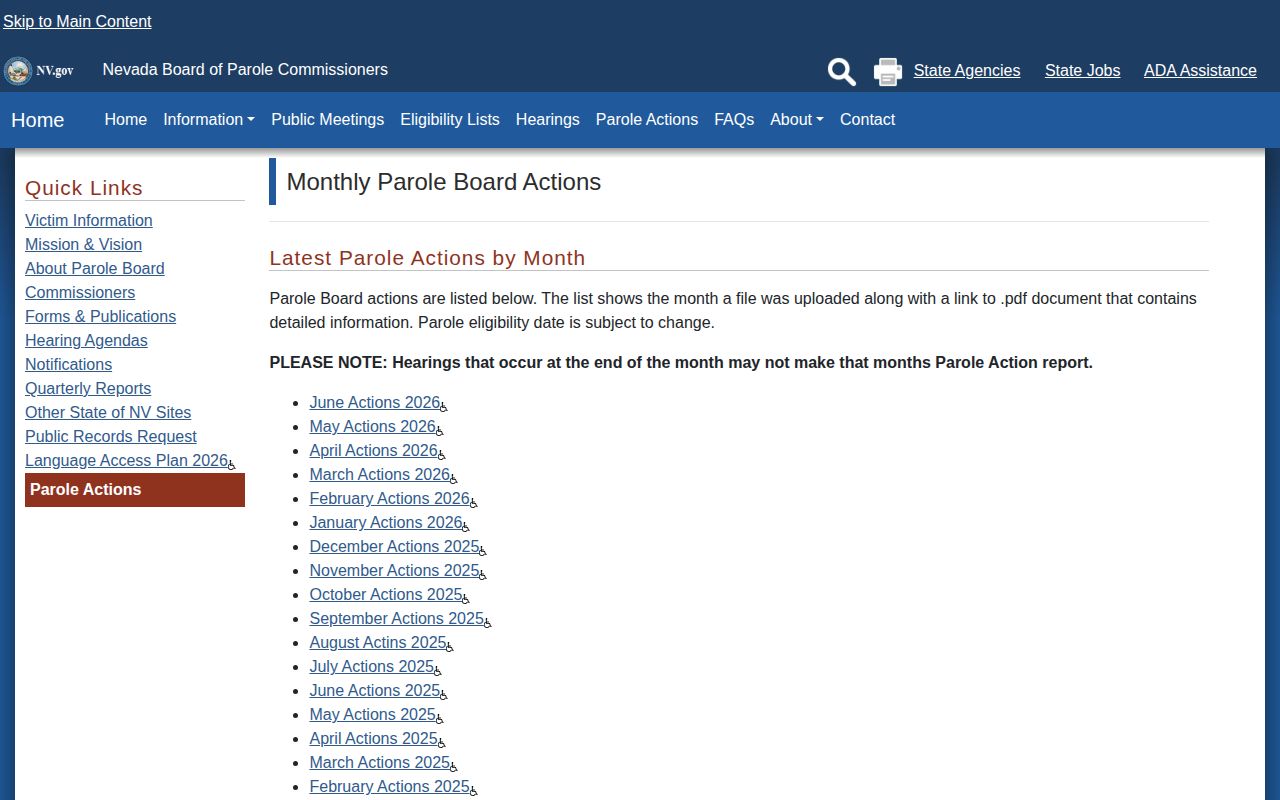
A hearing near month end may appear in the next report, so search both the hearing month and the following action upload.
Eligibility itself comes from NRS Chapter 213, the sentencing statute, and any credits that lawfully affect the minimum term. Some offenses exclude the usual credit treatment. NRS 213.1215 also addresses mandatory release for certain prisoners before the reduced maximum term, subject to exceptions. These rules cannot be reduced to one formula without the offense date and judgment. A calendar date is best treated as a lead for the correct Board file, not a stand-alone forecast.
Lincoln County Release Placement
An eligibility date does not place someone in the community. Nevada P&P's Pre-Release Unit verifies a proposed placement before parole release and coordinates interstate matters. An address can be rejected or require more review. This work explains why a favorable Board decision and the NDOC release entry may carry different dates.
Residential confinement also needs exact wording. P&P may supervise the placement, but Nevada still considers the person an inmate. It is not unconditional release. Likewise, transfer to another NDOC institution is movement within custody, not parole or discharge.
The official Pre-Release Unit page documents verified placement and residential confinement.
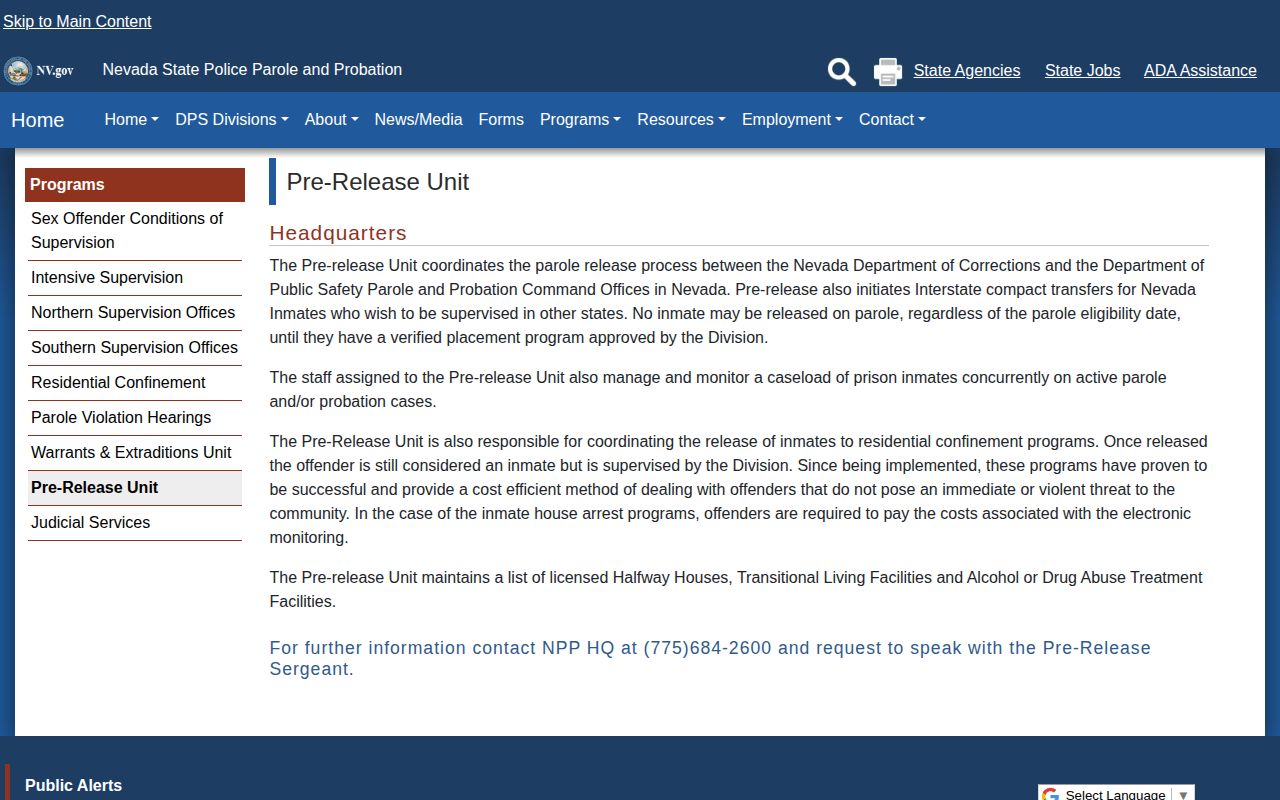
That distinction should be carried into any personal timeline: Board action, placement approval, NDOC departure, and supervision are separate events.
Lincoln County Supervision Warrants
A missed report or alleged breach does not prove that a person has been found in violation. When a parolee or probationer absconds, P&P's Warrants and Extraditions Unit handles the case and enters or clears warrants through NCIC and CJIS. A public flyer can become stale. Confirm current warrant status with the authorized unit or court channel before relying on it.
The unit publishes 775-684-2644 and nppmostwanted@dps.state.nv.us. A Board violation agenda shows an allegation and a scheduled process. It does not establish guilt, and it does not always show where the person is now. If the person was arrested, the holding jail owns the current custody answer.
Conditions vary with the controlling order. They can include reporting, approved travel or residence, and other limits set by the court, Board, or supervising agency. A condition-modification record shows that a change was considered or made, but only the final order establishes its terms. When a status question concerns a fresh arrest, check the new jail and court case as well as P&P. One source rarely captures the full sequence.
Request Lincoln County Discharge Records
P&P's request form contemplates sentence-expiration and discharge information, including a discharge document. Ask for the minimum existing record needed. Useful identifiers include the person's name and aliases, case number, birth date, sentence date and type, expiration date, and discharge date. A presentence investigation may remain confidential even when a narrower discharge record can be released.
County jail records use a separate path. The Lincoln County request form accepts email, mail, and in-person submissions for identifiable existing police records under Nevada's public-record framework. Describe the exact booking or release record. Do not send extra private data. The request and response may themselves become publicly viewable.
The Sheriff's forms page explains the local process. Nevada agencies may redact or withhold protected portions, but a requester can ask for the legal basis and for reasonably separable public material. NRS 239.0107 provides a five-business-day response framework, not a promise that every record will be produced in five days.
The county form states that extraordinary work can be calculated at $35 per staff hour. That is not a flat charge for every request. Ask for electronic delivery and a cost estimate before extraordinary work begins. Juvenile records are excluded from the Sheriff's public request route, and sealed or otherwise protected material may not be released. Narrow language improves both accuracy and response speed.
Lincoln County Supervision Discharge
Supervision ends through sentence expiration, a lawful early discharge, or another controlling order. Do not infer discharge from a missing S.A.V.E. result. Nevada S.A.V.E. can search participating custody or supervision data, but its FAQ says people no longer in custody may not appear. Automated information is not an official NDOC record.
For a state-prison case, align the NDOC offender and release identifiers with the P&P discharge record. For probation, obtain the court's final order. Keep the jail release timestamp distinct from both. This record chain shows when physical confinement ended, whether supervision followed, and when that later duty formally closed.
A registry entry, old Board report, or closed jail booking cannot replace that final discharge record.